



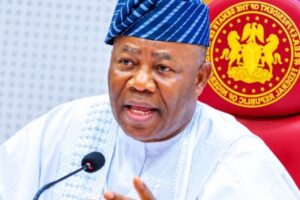







Senate President Godswill Akpabio has defended himself against criticism over his recent comments about Islam during a Senate debate, declaring that he has supported Muslim pilgrimages to Mecca for 25 years and would not deliberately disrespect the religion.
Akpabio made the clarification on Thursday, October 15, 2026, while responding to public criticism of his remarks during deliberations on the Suicide Prevention Bill 2026. He said his comments had been taken out of context and interpreted unfairly, insisting that his record of supporting both Muslim and Christian pilgrims demonstrated his respect for different religious communities.
AKPABIO CITES 5,800 MUSLIM PILGRIMS IN DEFENCE OF HIS REMARKS
During his response in the Senate, Akpabio said he sponsored 5,800 Muslims to the Holy Land while serving as governor of Akwa Ibom State. He also claimed to have supported more than 10,000 Christians travelling to Rome and Jerusalem.
The Senate President maintained that he had maintained relationships with people of different faiths throughout his political career. He also cited his long-serving aide-de-camp, who is Muslim, as an example of the relationships he has built across religious lines.
Akpabio said he had been sending people to Mecca to pray for him and Nigeria for approximately 25 years. He argued that these actions contradicted suggestions that he intended to insult Islam or its followers.
However, his defence has also raised a broader question about how public officials should respond when their statements are perceived as offensive. While Akpabio points to his record of religious support, critics may argue that the impact of a public statement should also be considered independently of the speaker’s personal relationships or past contributions.
SUICIDE PREVENTION BILL TRIGGERS RELIGIOUS CONTROVERSY
The controversy followed comments Akpabio made during the Senate’s consideration of the Suicide Prevention Bill 2026, sponsored by Senator Asuquo Ekpenyong of Cross River South.
During the debate, Akpabio referred to the belief that some people who engage in suicide attacks expect rewards in the afterlife. His remarks drew criticism from commentators who considered the wording insensitive to Muslim beliefs and potentially capable of reinforcing negative associations between Islam and violence.
Responding to the criticism, Akpabio rejected the idea that terrorism should be associated with any particular religion. He argued that terrorists should be held responsible for their actions rather than having their conduct used to define an entire religious community. He also stated that Islam prohibits suicide and killing.
The debate highlights the need for care when lawmakers discuss sensitive subjects involving religion, mental health and suicide. A legislative discussion may require examining difficult beliefs and behaviours, but the choice of words can influence how different communities understand the debate.
The Suicide Prevention Bill has also brought attention to the question of whether people who attempt suicide should face criminal penalties or receive medical treatment, rehabilitation and psychological support. The bill was referred to Senate committees for further consideration, according to reports.
Akpabio has urged Nigerians to consider the full context of Senate deliberations and the final decisions reached by lawmakers rather than judging proceedings solely by isolated comments. Nevertheless, the reaction demonstrates how statements made in the chamber can generate public controversy beyond the immediate legislative issue. Senate President Godswill Akpabio has responded to criticism over his comments on Islam by citing his reported sponsorship of 5,800 Muslim pilgrims to Mecca and more than 10,000 Christians to Rome and Jerusalem. He insists that he respects both faiths and that his remarks during the Senate debate were misinterpreted.
The controversy raises two important issues: the responsibility of public officials to communicate carefully on sensitive religious matters, and the importance of allowing lawmakers to debate legislation without turning criticism into hostility towards religious communities. OGM News NG will continue to follow developments surrounding the Senate debate, the Suicide Prevention Bill 2026 and reactions from political and religious stakeholders.
Table of Contents
Discover more from OGM News NG
Subscribe to get the latest posts sent to your email.