

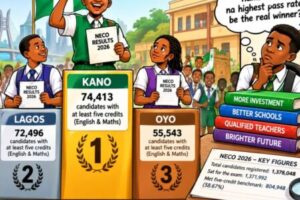






Kano Leads the 2026 NECO table as 74,413 candidates from the state reportedly secure at least five credits, including English Language and Mathematics, putting Lagos and Oyo behind for this particular performance measure. As the result enter public space, one question dey hang for air: Kano really dominate the whole education competition, or na the particular number NECO use measure wey dey tell the story?
The figures released alongside the 2026 Senior School Certificate Examinatio496 candidates meeting the same benchmark, while Oyo recorded 55,543. Kano’s latest figure also means the state has recorded the highest number under this benchmark for two consecutive years, after its 2025 performance.
Kano Leads Again as Students Collect Their Result
Kano Leads the chart with 74,413 candidates obtaining at least five creditsathematics. Lagos follows with 72,496, while Oyo comes third with 55,543. So, for this particular NECO measurement, Kano don collect first position again—and apparently the state no wan release the chair anytime soon.
Governor Abba Kabir Yusuf congratulated students, teachers, parents and other stakeholders, describing the back-to-back performance as evidence that the state’s investment in education was producing measurable results. The governor said Kano government spent more than N4.4 billion in 2026 to sponsor candidates, particularly indigent students, while other interventions include classroom renovation, teacher recruitment and training, learning materials,uniforms and school supplies.
The Small Print Wey NECO Numbers Carry
Kano Leads when the measurement is the number of candidates who obtained at least five credits including English and Mathematics. But this distinction important because “leading by number” no automatically mean Kano has the highest percentage pass rate among all states. More candidates in a state can contribute to a larger absolute figure, eparate the raw total from the proportion of candidates who succeeded.
At national level, NECO said 1,378,048 candidates registered for the 2026 SSCE Internal examination, while 1,371,992 actually sat for the papers. Out of those who sat, 804,948 candidates—58.67 per cent—obtained at least five credits including English Language and Mathematics. NECO also reported that, when five credits were considered without requiring English and Mathematics, the South-West had the highest regional proportion at 24.60 per cent, followed by the North-West at 22.10 per cent.
The Kano government has connected the result with its wider education spending. It said education received N405.35 billion, approximately 30 per cent of the state’s N1.478 trillion 2026 budget, while the sector received N168.35 billion, or about 31 per cent, in the 2025 budget. Those figures provide useful context, although the NECO result by particular budget intervention caused the performance.
For Kano, the immediate story is celebration: students, teachers, parents and education officials have another result to point at. For Lagos and Oyo, the figures show strong absolute numbers too, even though they sit behind Kano on this particular table. And for everybody watching Nigerian education, t NECO statistics need careful reading—because sometimes the headline says “number one,” while the small print says, “abeg, check wetin we actually measure.”
Kano Leads the particular 2026 NECO benchmark for the second year running, but the wider education story still goes beyond one table. OGM News Pidgin go continue to watch the figures, funding, school conditions and learning outcomes as more detailed education data enter public discussion.
Table of Contents
Discover more from OGM News NG
Subscribe to get the latest posts sent to your email.