







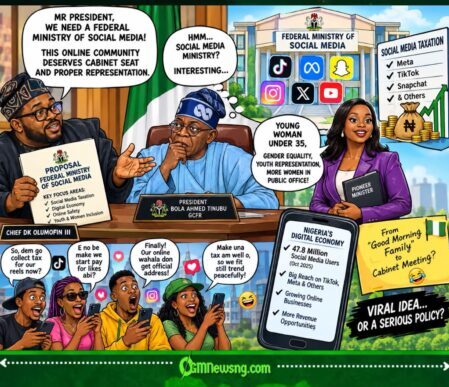
Federal Ministry of Social Media don become the latest political-policy conversation after Chief DK Olumofin III reportedly submitted a proposal to President Bola Ahmed Tinubu, asking the Federal Government to establish an independent ministry dedicated to social media and the wider online community. According to the proposal shared with OGM News Pidgin, Olumofin believes one of Nigeria’s most active and influential communities don become too important for government to leave without direct Cabinet representation. The big question now be whether the idea go remain proposal or eventually enter the serious Abuja policy machine.
Federal Ministry of Social Media: Olumofin Wants Tinubu To Give Social Media Cabinet Seat
According to the material provided, Olumofin wants the proposed Federal Media to focus on several areas connected to the country’s rapidly expanding digital space. One major area na Social Media Taxation, with the proposal asking government to develop appropriate taxation frameworks for Meta, TikTok, Snapchat and rating in Nigeria. The argument behind the idea be straightforward: where digital platforms generate economic activity, advertising money and commercial opportunities, government should have a clear and fair framework for revenue collection.
The proposal also recommends that President Tinubu consider a highly educated woman under 35 as the pioneer minister. Olumofin links the recommendation to gender equality, youth representation and greater inclusion of women in public office. If government ever adopts the proposal, the pioneer minister no go just need sabi social media trends; the office would likely require strong understanding of policy, taxation, technology, communications and the sometimes complicated relationship between government and online platforms. In other words, knowing how to trend for X no automatically qualify person for Federal Executive Council meeting.
Federal Ministry of Social Media: Finally, Nigerian Online Wahala Fit Get Its Own Minister
The argument for greater government attention to social media no come from empty internet air. Data Reportal’s latest Nigeria digital report esa had 47.8 million active social media user identities in October 2025, representing about 20 per cent of the population at the end of that year. The organisation also warns that these figures should not be interpreted as an exact count of unique individuals because one person fit have multiple accounts or appear across different platforms.
The same report shows just how significant individual platforms have become. TikTok’s advertising resources indicated potential reach on adults in Nigeria in late 2025, while Facebook’s advertising reach remained substantial. Again, advertising reach no be exactly the same thing as monthly active users, so the figures need proper interpretation. The wider point, however, remains clear: Nigeria’s online ecosystem has become large enough to influence commerce, entertainment, politics, advertising and public debate.
The taxation aspect of Olumofin’s proposal also enters a country wey already dey reform how government collects revenue. The Federal Government says the Tax Acts 2025 became effective from January 1, 2026, with the new framework covering tax administration and compliance under the reformed system. The Nigeria Revenue Service is also pushing technology-based administration, including electronic invoicing and digital taxpayer services.
But creating a new Federal Ministry of Social Media would raise another serious policy issue: whether the country really needs a completely new ministry or whether existing institutions can simply receive clearer responsibilities and better coordination. The Federal Ministry of Communications, Innovation and Digital Economy said in July 2026 that regulation of internet platforms, online intermediaries and related digital matters currently involve overlapping responsibilities among different regulators, making harmonised policy necessary.
That point fit become the main wahala for Olumofin’s proposal. If one new ministry enters the picture without clearly defining where its authority starts and where agencies like the Nigeria Communications Commission, NITDA, the Nigeria Data Protection Commission and the Nigeria Revenue Service stop, Abuja fit accidentally create one more office for everybody to ask, “Who suppose handle this matter?” The government itself has already acknowledged the need for coordination across digital platforms, online safety, data governance and artificial intelligence.
For the proposed Social Media Taxation, another important matter na balance. Government wants revenue, but digital businesses also need predictable rules that do not discourage investment, innovation or legitimate online entrepreneurship. Nigeria’s Finance Ministry has repeatedly linked modern tax administration with broadening the tax base, improving compliance and supporting economic growth, while current reforms increasingly depend on technology.
Any future framework for platforms such as Meta, TikTok or Snapchat would therefore need to make clear who pays, what activities are taxable, henforced and how double taxation or unnecessary regulatory overlap would be avoided.
The proposal to appoint a woman under 35 as pioneer minister also deserves to be separated from the bigger question of whether the ministry itself makes policy sense. Youth and women representation are legitimate public-policy issues, but competence, experience and the ability to coted digital sector would equally matter if such an office ever becomes reality. The internet fit love somebody because she sabi trend, but Federal Government no dey run on likes and comments.
For now, Olumofin’s proposal remains a proposal, and there is no indication in the material provided that President Tinubu has approved the creation of such a ministry. But the idea has opened an interesting conversation about whether Nigeria’s online community has become economlly important enough to deserve a dedicated institutional structure. As Social Media Taxation and digital regulation continue to attractidgin go dey watch whether this proposal remains another viral Abuja idea or eventually graduates from social media post to government policy document.
Table of Contents
Discover more from OGM News NG
Subscribe to get the latest posts sent to your email.