







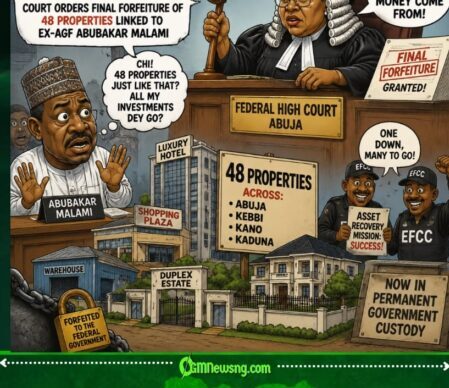
Abuja don witness another major legal drama as the Federal High Court order the final forfeiture of 48 properties valued at about N212 billion, assets wey EFCC link to former Attorney-General of the Federation and Minister of Justice, Abubakar Malami. The decision don create fresh N212 BILLION PROPERTY STORM as Nigerians dey ask how properties worth such massive amount enter legal battle and wetin the next chapter go bring.
The court decision, delivered by Justice Joyce Abdulmalik, remove temporary uncertainty surrounding the assets after objections from Malami, some family members and companies claiming ownership were dismissed. The ruling has turned the properties into one of the biggest asset recovery stories under public discussion, proving again that even buildings with golden appearance can still face serious courtroom questions.
N212 BILLION PROPERTY STORM: Court Focuses On Source Of Wealth, Not Just Ownership
The original issue before the court was not simply about who claimed ownership of the properties, but whether the funds used to purchase them were obtained through lawful means. According to the judgment, the claimants failed to present enough evidence to convince the court that the assets were acquired through legitimate financial sources.
The properties involved reportedly include hotels, duplexes, shopping plazas, warehouses, commercial buildings and housing estates located across Abuja, Kebbi, Kano and Kaduna states. The EFCC’s application argued that the assets were connected to questionable financial activities, while those affected challenged the forfeiture process.
The court’s position created a serious message for asset ownership in Nigeria: having documents, companies or family names attached to properties may not automatically end the conversation if questions remain about the origin of the funds. As the legal saying goes, house no fit speak, but money trail fit talk.
N212 BILLION PROPERTY STORM: Bigger Fight Against Financial Crimes Continues
Beyond this particular case, the development connects with Nigeria’s wider effort to recover assets believed to have been acquired through unlawful means. EFCC has continued pursuing asset recovery cases involving individuals, businesses and public figures as part of efforts to strengthen financial accountability.
Abubakar Malami served as Nigeria’s Attorney-General of the Federation and Minister of Justice from 2015 to 2023 during the administration of former President Muhammadu Buhari. Since leaving office, his name has appeared in various public debates concerning governance and accountability, though legal proceedings remain the proper avenue for determining responsibility.
The latest N212 BILLION PROPERTY STORM also highlights a common challenge in anti-corruption battles: recovering assets can be easier said than done because ownership structures, company arrangements and legal objections often create complicated courtroom processes. For ordinary Nigerians watching from outside, the message is simple — expensive properties may attract attention, but evidence remains the real landlord inside the courtroom.
The final forfeiture order represents a significant victory for EFCC’s recovery efforts, but the wider conversation about transparency, public service and wealth accumulation is far from finished. As Nigeria continues watching this N212 BILLION PROPERTY STORM, future legal developments may determine whether this case becomes a turning point or simply another major chapter in the country’s long-running accountability debate.
Table of Contents
Discover more from OGM News NG
Subscribe to get the latest posts sent to your email.