









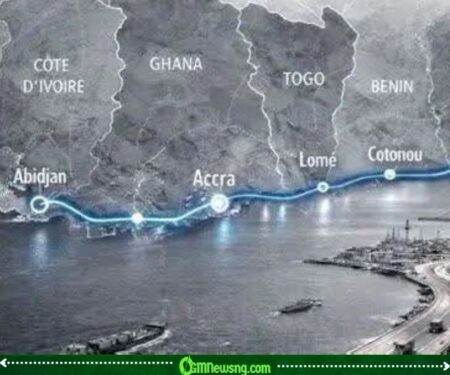
Abidjan-Lagos Highway is once again at the centre of West Africa’s integration ambitions after five countries formally confirmed the operational launch of the Abidjan-Lagos Corridor Management Authority, the body that will oversee one of Africa’s largest transport infrastructure projects. The announcement has renewed hopes that a single highway stretching from Lagos to Abidjan could dramatically reshape trade and mobility across the region, even as questions remain about financing, implementation and whether decades-old border delays can truly become a thing of the past.
Five Countries Unite to Build 1,028km Abidjan-Lagos Highway Across West Africa
The Abidjan-Lagos Highway is a 1,028-kilometre, six-lane dual carriageway designed to connect Nigeria, Benin, Togo, Ghana and Côte d’Ivoire through a modern coastal transport corridor. The project, valued at approximately $15.6 billion, is expected to pass through eight international border crossings and link major economic centres including Lagos, Cotonou, Lomé, Accra and Abidjan. Near Lagos, some sections of the highway are expected to expand to eight lanes to accommodate higher traffic volumes.
The newly operational Abidjan-Lagos Corridor Management Authority, known as ALCoMA, emerged following the swearing-in of its governing board and a series of orientation sessions involving ECOWAS and the African Development Bank Group. The authority has been tasked with developing governance procedures, coordinating implementation and preparing for the construction and maintenance phases of the project. Officials expect the highway to significantly reduce transport delays that can currently keep cargo trucks waiting for up to 72 hours at some border crossings.
Abidjan-Lagos Highway Raises Big Hope and Bigger Questions for Regional Leaders
The Abidjan-Lagos Highway is also increasingly being described as a critical pillar for the success of the African Continental Free Trade Area. In April 2026, the African Development Bank and its partners concluded a multi-country mission aimed at mobilising financing for the corridor, holding discussions with ministers and financial institutions across the five participating nations. The mission underscored the project’s importance not merely as a road but as a strategic economic corridor intended to support industrialisation, logistics development and regional value chains.
Beyond the road itself, discussions have also included future plans for a parallel high-speed railway and broader economic hubs along the corridor. Estimates suggest the project could generate around $16 billion in trade and approximately $1.3 billion in toll revenues for the participating countries. Such figures have fuelled optimism, though analysts caution that major cross-border projects often face financing pressures, political transitions and implementation challenges that can delay timelines. The 2030 target, therefore, remains ambitious and will depend heavily on sustained cooperation among the five governments and their development partners.
For now, the Abidjan-Lagos Highway represents more than concrete and asphalt. It embodies the long-standing dream of regional integration in West Africa—a vision where crossing borders becomes easier than crossing a traffic junction. Whether this superhighway ultimately becomes an economic revolution or another monument to unrealised ambition will depend on what happens after the ceremonies, the speeches and the promises. OGM News Nigeria will continue to monitor developments as construction preparations advance toward the 2030 deadline.
Table of Contents
Discover more from OGM News NG
Subscribe to get the latest posts sent to your email.