








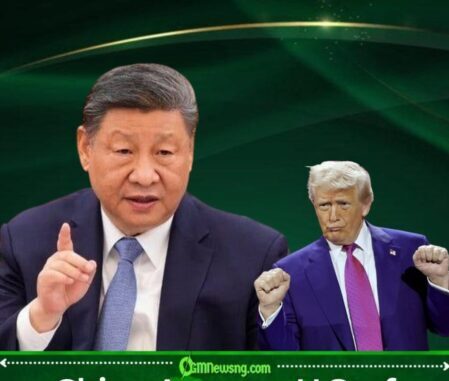
National Security has once again become the center of a growing dispute between China and the United States, with Beijing accusing Washington of using security concerns as a convenient justification to suppress and restrict Chinese Firms. The latest accusations come as U.S. authorities continue imposing measures on Chinese companies operating in strategic industries, prompting Chinese officials to argue that what is being presented as a security issue increasingly resembles an economic competition strategy. As tensions rise between the world’s two largest economies, the debate is raising difficult questions about where genuine security concerns end and commercial rivalry begins.
China Says National Security Has Become Washington’s Favorite Business Weapon
Chinese officials have strongly criticized recent U.S. actions affecting several major Chinese companies, arguing that National Security has become a broad label applied to an expanding list of industries. According to Beijing, restrictions targeting technology firms, telecommunications providers, electric vehicle manufacturers, and advanced industrial companies demonstrate a pattern that goes beyond traditional defense concerns. Chinese authorities maintain that many of the affected businesses operate as commercial enterprises and should not automatically be treated as security threats simply because they originate from China.
The criticism reflects growing frustration within Beijing over what it views as unequal treatment in global markets. Chinese representatives have argued that repeated restrictions damage business confidence and create uncertainty for investors. In unusually direct language, officials have accused Washington of turning economic disagreements into security disputes, suggesting that successful Chinese Firms are increasingly finding themselves under scrutiny regardless of their actual activities. The message from Beijing is clear: China believes commercial competition is being rebranded as a matter of national defense.
China Accuses Washington of Hiding Trade Restrictions Behind Security Claims
The latest dispute follows a series of U.S. measures involving export controls, investment restrictions, and government blacklists affecting Chinese companies. American officials have consistently defended these actions as necessary safeguards designed to protect sensitive technologies, critical infrastructure, and strategic industries. Beijing, however, argues that National Security has become an overly flexible justification capable of being applied whenever policymakers wish to limit foreign competition.
Chinese officials contend that these restrictions are creating barriers that affect not only individual companies but also wider international supply chains. Businesses that once focused on expanding markets and attracting investment now find themselves navigating increasingly complex political considerations. Critics within China argue that some firms appear to be facing penalties not because of proven misconduct but because of broader geopolitical concerns. The result, according to Beijing, is a business environment where uncertainty has become almost as valuable a policy tool as regulation itself.
Chinese Firms Caught in Growing U.S.-China Power Struggle, Beijing Says
Beyond the immediate disagreement lies a larger contest over technological leadership, economic influence, and global power. Chinese Firms have become key players in sectors such as artificial intelligence, electric vehicles, semiconductors, renewable energy, and advanced manufacturing. These industries are widely viewed as crucial to future economic growth, making them strategic assets in an increasingly competitive international landscape.
Observers note that the current dispute reflects a broader shift in how major powers approach economic policy. Issues that were once considered purely commercial are now frequently discussed through the lens of National Security. Governments are paying closer attention to supply chains, technology transfers, data protection, and industrial capabilities. In this environment, companies often find themselves caught between competing national interests, with business decisions becoming entangled in diplomatic and geopolitical calculations.
There is also a growing concern among international investors that prolonged tensions could reshape global trade patterns for years to come. As both countries continue defending their positions, businesses around the world are watching closely for signs of escalation or compromise. The outcome could influence investment decisions, manufacturing strategies, and technological cooperation across multiple industries. For many companies, the challenge is no longer simply building better products but adapting to a world where politics and commerce are increasingly difficult to separate.
The debate surrounding National Security and Chinese Firms is unlikely to disappear anytime soon. While Beijing insists that commercial competition should not be disguised as security policy, Washington maintains that strategic concerns require stronger safeguards than ever before. As both governments continue exchanging criticism and defending their respective approaches, the global business community is left navigating a landscape where every new restriction raises the same question: is this about security, competition, or a mixture of both? OGM News Nigeria will continue monitoring developments as this high-stakes economic and political contest evolves.
Table of Contents
Discover more from OGM News NG
Subscribe to get the latest posts sent to your email.