






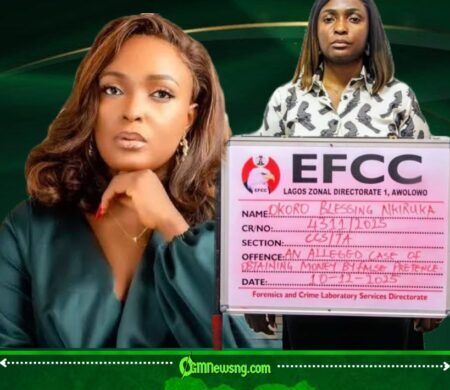
The EFCC and popular social media personality Blessing CEO collided dramatically inside a Federal High Court in Lagos on Friday, after the anti-graft agency arraigned the self-acclaimed relationship therapist over allegations involving ₦36 million obtained under false pretence. What initially appeared to be another internet controversy quickly evolved into a serious courtroom battle after prosecutors insisted that repayment discussions could not erase criminal proceedings already initiated by the Federal Government of Nigeria.
EFCC Embarks on the Arraignment of Blessing CEO
According to the EFCC, Blessing CEO, whose real name is Okoro Blessing Nkiruka, faces a two-count charge bordering on obtaining money by false pretence and alleged stealing involving ₦36 million. The arraignment took place before Justice D.I. Dipeolu at the Federal High Court sitting in Ikoyi, Lagos, where proceedings immediately drew intense public attention because of the influencer’s celebrity status and strong social media presence.
During the hearing, defence counsel P.I. Nwafor informed the court that the defendant had already refunded ₦24 million to the petitioner. The lawyer further requested a short adjournment to allow conversations over the outstanding balance to continue, adding that the nominal complainant was willing to facilitate withdrawal of the matter if the balance was eventually settled. However, prosecution counsel S.I. Suleiman rejected any attempt to shift the matter into a private settlement arrangement, stressing that the complainant before the court remained the Federal Government of Nigeria, not an individual negotiator seeking compensation.
Nigerians Demand Accountability in this Case
Justice Dipeolu eventually ruled that settlement discussions could continue independently without interfering with the judicial process, insisting that the defendant must still take her plea before the court. The decision immediately triggered wider public conversations about how celebrity culture, influencer branding and legal accountability increasingly collide in Nigeria’s digital era.
The Blessing CEO EFCC case also reflects a growing pattern in which online personalities with massive audiences face heightened scrutiny over financial dealings, public claims and business arrangements. In recent years, Nigerian anti-graft agencies have intensified investigations involving public figures, social media celebrities and online entrepreneurs, especially in cases where complainants allege financial deception or abuse of public trust. Legal analysts note that repayment of disputed funds may influence public perception but does not automatically terminate criminal proceedings once the state assumes responsibility for prosecution.
For many Nigerians, the courtroom exchange became more symbolic than procedural. The hearing highlighted the widening gap between internet popularity and institutional accountability, especially at a time when influencers increasingly shape public opinion, business transactions and emotional decision-making online. While supporters of Blessing CEO continue to argue that repayment efforts demonstrate responsibility, critics insist the legal process must run independently of social media sentiment and negotiated settlements.
As proceedings continue, attention will remain fixed on whether additional repayments, legal arguments or further evidence could influence the direction of the case. OGM News Nigeria will continue monitoring developments surrounding the EFCC prosecution, the court’s subsequent rulings and the wider conversations emerging around celebrity influence, public trust and financial accountability in Nigeria’s rapidly expanding social media economy.
Table of Contents
Discover more from OGM News NG
Subscribe to get the latest posts sent to your email.