









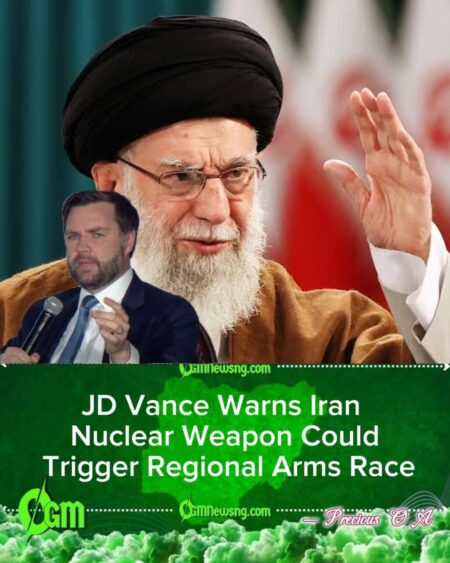
JD Vance said that if Iran were to acquire a nuclear weapon, Saudi Arabia would respond by pursuing its own nuclear capability, underscoring what he described as the risks of rapid proliferation in the Middle East. The remarks were framed as a warning about cascading security consequences rather than a prediction of imminent action.
The vice president’s comments come amid renewed international scrutiny of Iran’s nuclear program and heightened tensions surrounding regional security guarantees. Analysts note that such statements reflect longstanding concerns among U.S. policymakers about deterrence dynamics in the Gulf.
JD Vance’s remarks were delivered in the context of broader discussions on nuclear nonproliferation, emphasizing that one state’s nuclear advancement could alter strategic calculations across multiple capitals.
JD Vance and the Logic of Deterrence
JD Vance argued that nuclear decision-making in the Middle East cannot be viewed in isolation, suggesting that rival states closely monitor each other’s capabilities and intentions. He stressed that security policies in the region tend to be reactive rather than unilateral.
JD Vance said Saudi Arabia would be unlikely to remain without a deterrent if Iran crossed the nuclear threshold, citing regional balance-of-power considerations that have shaped Middle Eastern geopolitics for decades.
Experts note that this logic aligns with classical deterrence theory, in which states seek parity to avoid vulnerability, even if such moves increase overall instability.
Saudi Arabia’s Strategic Calculations
Saudi Arabia has repeatedly stated that it does not seek nuclear weapons, while also affirming its right to peaceful nuclear energy under international agreements. Regional observers say the kingdom’s public posture reflects a careful balance between reassurance and deterrence.
JD Vance referenced this ambiguity, noting that Saudi leaders have historically tied their long-term security posture to regional developments rather than unilateral ambition.
Diplomats familiar with Gulf politics suggest that Saudi Arabia’s decisions would likely depend on international guarantees, alliance credibility, and the perceived effectiveness of global nonproliferation frameworks.
Regional Security and Escalation Risks
JD Vance warned that a nuclear arms race in the Middle East would dramatically raise the risk of miscalculation, particularly in a region already shaped by proxy conflicts and shifting alliances.
Security analysts note that additional nuclear-capable states could complicate crisis management, increase pressure on early-warning systems, and reduce decision-making time during periods of tension.
Regional governments have expressed concern that proliferation could undermine decades of diplomatic efforts aimed at limiting weapons of mass destruction.
JD Vance on U.S. Policy and Diplomacy
JD Vance emphasized that U.S. policy remains focused on preventing nuclear proliferation through diplomatic engagement, sanctions enforcement, and international coordination. He said Washington views prevention as far preferable to managing consequences after the fact.
JD Vance added that American security commitments in the region are intended to reduce incentives for nuclearization among U.S. partners, reinforcing the importance of credibility and consistency.
Policy experts note that these statements reflect a broader U.S. strategy of combining deterrence with diplomatic pressure to maintain regional stability.
Global Implications and Future Outlook
Beyond the Middle East, analysts say nuclear proliferation would have global consequences, potentially weakening existing arms-control regimes and emboldening other states to reconsider their commitments.
JD Vance said international cooperation remains essential, arguing that nonproliferation is not solely a regional issue but a cornerstone of global security.
As diplomatic efforts continue, officials stress that preventing a nuclear cascade will require sustained engagement, credible enforcement mechanisms, and renewed dialogue among regional and global powers.
Table of Contents
Discover more from OGM News NG
Subscribe to get the latest posts sent to your email.