








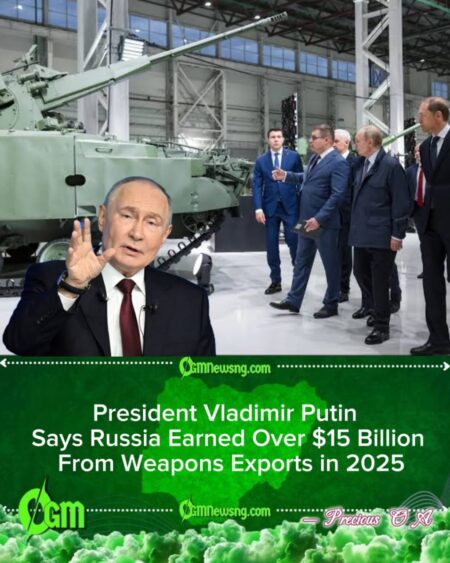
President Vladimir Putin said Russia generated more than $15 billion in weapons exports in 2025, portraying the result as evidence that the country’s defense industry continues to operate effectively despite sustained Western pressure. Speaking on the performance of the arms sector, he framed the figure as proof of resilience amid sanctions, restrictions on technology transfer, and heightened scrutiny of international military trade.
President Vladimir Putin emphasized that Russian defense manufacturers had adapted to shifting global conditions by diversifying export destinations and modernizing production lines. He argued that long-standing relationships with international partners, combined with new markets, helped sustain demand for Russian military equipment throughout the year.
The remarks were delivered as Moscow continues to position its arms industry as a cornerstone of national economic strategy. Officials have repeatedly highlighted defense exports as both a revenue source and a diplomatic tool, reinforcing military cooperation with partner states while supporting domestic industrial employment.
Export Markets and Global Demand
President Vladimir Putin said the reported revenue reflected steady demand across several regions, including parts of Asia, Africa, and the Middle East. He noted that longstanding clients continued to place orders for air defense systems, armored vehicles, and aviation equipment, while newer customers sought cost-effective alternatives to Western suppliers.
Analysts note that Russia’s arms export portfolio has traditionally appealed to governments seeking relatively affordable systems with fewer political conditions attached. This positioning has allowed Moscow to remain competitive in markets where buyers prioritize operational capability and price over interoperability with NATO-standard equipment.
President Vladimir Putin also pointed to after-sales services, maintenance contracts, and training programs as key contributors to overall export earnings. These ancillary services, he said, deepen long-term partnerships and generate sustained income beyond initial equipment sales.
President Vladimir Putin on Sanctions and Industry Adaptation
The impact of Western sanctions on Russia’s defense sector has been a focal point of international debate. Restrictions on advanced components and financial transactions were designed to constrain production capacity and limit export potential, particularly for high-technology systems.
President Vladimir Putin argued that the industry responded by accelerating domestic substitution programs and strengthening supply chains within Russia and friendly countries. He claimed these measures reduced vulnerability to external pressure while maintaining production timelines for export orders.
President Vladimir Putin added that state investment played a critical role in stabilizing manufacturers and supporting research and development. According to his comments, targeted funding and policy support allowed firms to continue innovating despite reduced access to some foreign technologies.
Economic Significance at Home
Beyond foreign sales, Russia’s weapons exports have implications for the domestic economy. Defense manufacturing supports a wide network of subcontractors, research institutes, and regional economies where major plants are located.
President Vladimir Putin said export revenues help sustain employment and preserve technical expertise across the defense sector. He linked the industry’s performance to broader economic stability, particularly in regions where military production represents a significant share of industrial output.
At the same time, economists caution that reliance on defense exports carries risks, including exposure to geopolitical shifts and fluctuations in global demand. They note that sanctions can still complicate logistics, financing, and long-term planning, even when headline revenue figures appear strong.
International Reactions and Strategic Implications
President Vladimir Putin framed the $15 billion figure as a message to critics who predicted a sharp decline in Russia’s global defense presence. He suggested that continued export activity demonstrates the limits of economic pressure as a tool for reshaping Moscow’s strategic behavior.
International observers, however, point out that transparency around arms deals remains limited. Independent verification of export values is challenging, and reported figures may aggregate contracts signed over multiple years or include services alongside equipment sales.
The continuation of Russian arms exports also carries strategic implications, as recipient states may deepen military ties with Moscow. This dynamic has drawn attention from Western governments concerned about the diffusion of advanced weapons systems and the geopolitical influence that accompanies defense cooperation.
Outlook for Russia’s Arms Trade
Looking ahead, Russia’s ability to sustain high levels of weapons exports will depend on several factors, including production capacity, technological development, and the evolving international sanctions environment. Competition from other suppliers, particularly China and emerging defense exporters, is also intensifying.
While the government remains confident, industry specialists note that maintaining competitiveness will require ongoing investment and innovation. Shifts in global security priorities, budget constraints among buyers, and diplomatic realignments could all influence future demand.
As 2026 approaches, Russia’s defense export strategy is likely to remain closely tied to broader foreign policy goals. Whether the reported performance in 2025 represents a stable trend or a temporary outcome will become clearer as new contracts are disclosed and market conditions continue to evolve.
Table of Contents
Discover more from OGM News NG
Subscribe to get the latest posts sent to your email.