




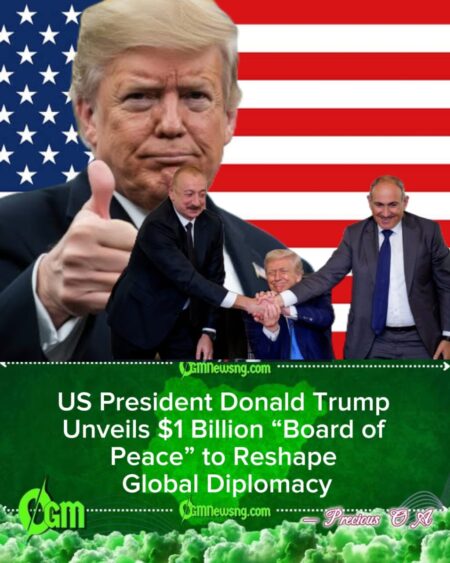
US President Donald Trump announced a groundbreaking initiative that would charge countries $1 billion for a permanent seat on a newly proposed “Board of Peace.” According to Trump, the plan is designed to incentivize nations to invest in global security while giving the United States a leading role in shaping international policy. The announcement, reported by Bloomberg, immediately captured the attention of world leaders and financial markets alike.
US President Donald Trump emphasized that the initiative is not just about revenue but also about accountability, saying nations will now have a tangible stake in promoting peace and stability. By requiring a significant financial contribution, Trump argues, countries will be more committed to following through on agreements and reducing conflicts. Critics have already questioned the feasibility, but Trump maintains it will redefine global cooperation.
US President Donald Trump highlighted that the “Board of Peace” would function as a permanent advisory and decision-making body, with voting rights tied directly to the $1 billion investment. Nations that join would have ongoing influence over major security and diplomatic initiatives, positioning them at the forefront of international decision-making.
How the Board Will Work
The “Board of Peace” is envisioned as a permanent international council tasked with mediating conflicts, coordinating humanitarian efforts, and overseeing global security initiatives. US President Donald Trump has insisted that membership would not be symbolic; each participating country would have concrete responsibilities, financial obligations, and a clear role in policy implementation.
Supporters argue the $1 billion fee will fund operational logistics, conflict resolution missions, and global monitoring systems. The Board would also serve as a forum for addressing emerging threats, from cyber warfare to regional instability, with member nations held accountable to both financial and ethical standards.
While some world leaders have expressed interest, others remain skeptical, warning that the fee may exclude smaller nations from meaningful participation. US President Donald Trump has countered by suggesting alternative arrangements, including long-term payment plans or partnership programs, to ensure wider engagement.
US President Donald Trump and International Response
US President Donald Trump has already begun private discussions with key allies, framing the initiative as an opportunity to increase transparency and collaboration among powerful nations. European and Asian leaders are reportedly weighing the proposal, noting its potential to centralize decision-making but also questioning its cost and practicality.
Diplomats in Washington suggest that the plan could alter traditional alliances, as countries now consider both financial commitment and political influence in determining their foreign policy priorities. US President Donald Trump has highlighted that the U.S. would act as the guarantor of the Board’s operations, reinforcing America’s global leadership role.
Some analysts predict the “Board of Peace” could create tension with existing international bodies such as the United Nations, where smaller nations have equal voting rights regardless of financial contribution. US President Donald Trump insists, however, that the initiative complements existing institutions rather than replacing them.
Economic and Strategic Implications
US President Donald Trump’s plan would generate significant revenue, estimated in the tens of billions if multiple countries commit. Proponents argue the funds could directly support conflict prevention, disaster relief, and infrastructure projects in regions prone to instability.
Economists are analyzing the broader impact on global markets, noting that countries willing to pay $1 billion could also leverage influence over U.S. trade policies and foreign investments. US President Donald Trump has stated that financial participation in the Board would not guarantee favorable treatment, though the strategic advantage of permanent membership is undeniable.
Critics question whether financial contributions truly ensure peace or merely create another layer of political hierarchy. US President Donald Trump responds that accountability, combined with financial responsibility, will pressure nations to uphold agreements and prevent avoidable conflicts.
US President Donald Trump’s Justification
US President Donald Trump defended the initiative as both pragmatic and visionary, stressing that countries must contribute substantially to global governance to create lasting security. “It’s time nations invest in their own safety and ours,” Trump said, highlighting that previous attempts at multilateral peacekeeping often failed due to lack of resources and accountability.
Supporters point out that traditional global funding mechanisms, often voluntary or inconsistent, leave the U.S. bearing the largest financial and operational burden. US President Donald Trump argues that the $1 billion fee is both fair and necessary to ensure each nation has a tangible stake in global stability.
The initiative also signals a broader shift in Trump’s foreign policy approach, placing economic leverage at the center of diplomacy. US President Donald Trump believes that combining financial commitment with political influence will incentivize nations to act responsibly on the international stage.
Looking Ahead
Implementation of the “Board of Peace” will require legislative approval, international negotiations, and logistical planning. US President Donald Trump has already indicated that preliminary discussions are underway with major allies, while smaller nations are being consulted on how they might participate.
Legal scholars and policy experts anticipate intense debate over the constitutionality and international legality of charging nations for permanent membership. US President Donald Trump remains undeterred, asserting that the initiative represents a new era of practical, results-oriented diplomacy.
If the plan succeeds, it could permanently reshape international relations, creating a tiered system of participation and influence, with US President Donald Trump at the helm of this high-stakes global strategy.
Table of Contents
Discover more from OGM News NG
Subscribe to get the latest posts sent to your email.