




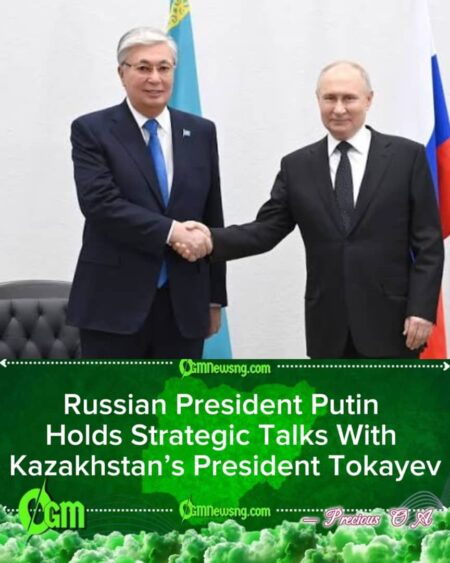
Russian president Putin met with Kazakhstan’s President Kassym-Jomart Tokayev for high-level talks aimed at strengthening bilateral relations and addressing shared regional challenges. The meeting, held in a formal diplomatic setting, underscored the long-standing political, economic, and security ties between the two neighboring countries.
Putin emphasized the importance of continued dialogue between Moscow and Astana, describing Kazakhstan as a key strategic partner in Central Asia. He noted that regular consultations help both countries align their interests on regional stability and economic development.
Putin also highlighted the historical relationship between Russia and Kazakhstan, pointing to decades of cooperation that have shaped trade, security coordination, and cultural exchange across their shared border.
Focus on Economic Cooperation
Putin said economic collaboration formed a central pillar of the discussions, with both leaders reviewing trade volumes, energy cooperation, and joint industrial projects. He stressed that Russia remains one of Kazakhstan’s largest trading partners.
Putin noted that cross-border infrastructure projects, including transport corridors and logistics hubs, were discussed as ways to boost regional connectivity and economic growth. These initiatives, he said, could benefit not only both countries but the wider Eurasian region.
Putin added that cooperation within multilateral economic frameworks would continue to play a role in stabilizing supply chains and promoting investment amid global economic uncertainty.
Regional Security and Stability
Putin addressed regional security concerns, including developments in Central Asia and neighboring regions. He said coordination between Russia and Kazakhstan is essential to counter shared threats such as extremism and cross-border crime.
Putin emphasized that security cooperation through regional organizations allows both countries to respond collectively to emerging risks while respecting national sovereignty.
Putin also underlined the importance of intelligence sharing and joint military exercises, describing them as confidence-building measures that contribute to long-term stability.
Kazakhstan’s Perspective
President Tokayev reaffirmed Kazakhstan’s commitment to maintaining constructive and balanced relations with Russia. He described the talks as productive and focused on practical outcomes rather than symbolic gestures.
Tokayev highlighted Kazakhstan’s interest in expanding economic diversification while maintaining strong partnerships with neighboring states. He said cooperation with Russia remains an important component of the country’s foreign policy strategy.
The Kazakh leader also stressed the value of dialogue in navigating regional complexities, noting that open communication helps prevent misunderstandings and strengthens mutual trust.
Broader Geopolitical Context
Analysts view the meeting as part of ongoing efforts by both countries to manage shifting geopolitical dynamics in Eurasia. Relations between major powers, energy markets, and regional alliances continue to influence policy decisions in both Moscow and Astana.
Observers note that Kazakhstan often positions itself as a bridge between different geopolitical blocs, seeking to balance its partnerships while protecting national interests. Talks with Russia are seen as central to maintaining that balance.
The discussions also come at a time when regional cooperation is increasingly shaped by economic resilience, security coordination, and diplomatic flexibility.
Officials from both sides indicated that further meetings and working-level consultations are planned to follow up on the agreements discussed. These engagements are expected to translate diplomatic dialogue into concrete policy actions.
Future cooperation is likely to focus on trade facilitation, energy collaboration, and regional infrastructure development, areas seen as mutually beneficial and strategically important.
As Russia and Kazakhstan continue their dialogue, the talks signal an intention by both leaders to preserve stability, deepen cooperation, and manage regional challenges through sustained diplomatic engagement.
Table of Contents
Discover more from OGM News NG
Subscribe to get the latest posts sent to your email.