









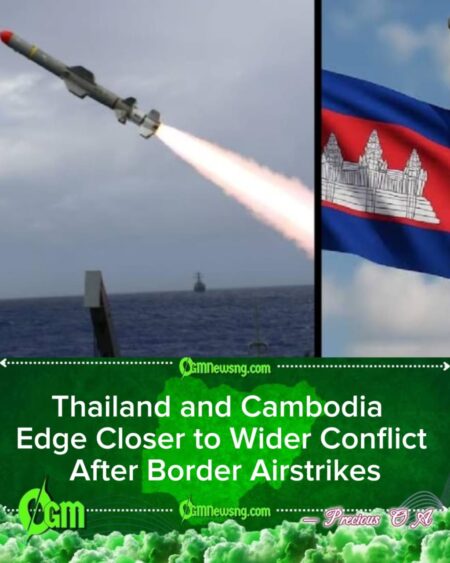
Thailand launched a new wave of airstrikes along the Cambodian border following an intense series of military clashes, marking one of the most serious escalations between the neighboring nations in recent years. The strikes were described as precise and targeted operations, yet their scope and timing have raised significant alarm among regional observers who warn that the conflict may deepen without immediate diplomatic intervention.
Thailand emphasized that the strikes were carried out in direct response to what officials labeled aggressive Cambodian cross-border incursions, asserting that defensive measures were necessary to prevent further destabilization. Government spokespersons stressed that intelligence reports indicated the presence of armed Cambodian units positioned dangerously close to contested territory.
Thailand reiterated that its armed forces acted under strict engagement rules, noting that military leadership had ordered additional reconnaissance flights, fortified artillery placements, and heightened surveillance systems to prevent further violations of sovereign land.
Military Operations Intensify
Thailand confirmed that ground forces were simultaneously deployed to strategic positions surrounding the disputed border villages, describing these moves as essential steps to prevent Cambodian forces from regaining tactical momentum. Field commanders reported fortified checkpoints, expanded troop rotations, and stepped-up air-support coordination to ensure uninterrupted defensive capabilities.
Thailand argued that these tactical decisions were informed by weeks of escalating tensions, during which multiple Cambodian patrol units had allegedly advanced beyond demarcated boundaries. Officials claimed that the latest military activity reflects an attempt to halt a pattern of provocation that threatens long-term stability.
Heightened regional anxiety is now driving increased intelligence-sharing among neighboring countries, with defense analysts warning that the rapid expansion of military operations risks drawing additional border communities into the conflict.
Diplomatic Fallout and Regional Tension
Thailand insisted that it remains open to diplomatic dialogue, but foreign-affairs officials stressed that negotiations cannot proceed while Cambodian forces maintain what they describe as unlawful positioning near the conflict zone. The foreign ministry emphasized that peaceful resolution is achievable only if both sides commit to de-escalation.
Thailand warned that Cambodia’s refusal to withdraw armed units from contested zones could force the continuation of military countermeasures, a stance that has drawn international attention. The government also highlighted that global partners should acknowledge the underlying security threats rather than prematurely calling for Thai restraint.
Regional diplomacy is becoming increasingly strained as ASEAN members quietly express concern that unresolved border tensions may weaken broader economic and security cooperation across Southeast Asia.
Humanitarian Concerns and Civilian Displacement
Thailand acknowledged that the renewed fighting has created significant hardships for civilians living in vulnerable frontline areas, prompting the government to initiate evacuation plans and establish temporary shelters. Humanitarian officers are monitoring population movements closely, warning that prolonged conflict could overwhelm available resources.
Thailand emphasized that military operations are being executed with deliberate caution to prevent unnecessary civilian casualties, though officials concede that the proximity of villages to active conflict zones makes risk-mitigation extremely difficult. The government is coordinating with local authorities to ensure safe-passage corridors remain open as fighting intensifies.
Relief organizations operating near the border caution that disrupted supply routes, destroyed farmland, and rising fear among villagers may lead to longer-term displacement, creating a growing humanitarian challenge for both nations.
Cambodia’s Response and Counterclaims
Thailand dismissed Cambodian statements alleging unjustified aggression, arguing that such claims ignore the documented violations that preceded the recent escalation. Officials maintain that military responses were triggered exclusively by Cambodian actions that jeopardized security and sovereignty.
Thailand countered that Cambodian leadership is attempting to reframe the narrative to avoid accountability for initiating hostilities, pointing to reconnaissance footage and radio communications that allegedly confirm the movements of Cambodian forces inside Thai territory. Senior officials argue that these records reveal a consistent pattern of provocation.
Cambodia, meanwhile, insists that its forces were operating within national boundaries and claims that Thai airstrikes represent a dangerous and disproportionate show of force, escalating diplomatic friction and increasing fears of broader conflict.
Future Outlook and Potential De-Escalation
Thailand stated that future operations will depend heavily on Cambodian military behavior, stressing that Thai forces will remain on high alert until credible commitments to de-escalation are demonstrated. Defense planners are reviewing additional defensive strategies designed to minimize further border instability.
Thailand clarified that despite the current intensity of operations, the long-term objective remains the preservation of peace and territorial integrity, not prolonged conflict. The government insists that military action is a last resort but will be used decisively whenever necessary to protect national boundaries.
Regional analysts warn that without structured negotiations, facilitated by ASEAN or another neutral mediator, the standoff may become a protracted confrontation with consequences for trade routes, migration flows, and geopolitical stability throughout Southeast Asia.
Table of Contents
Discover more from OGM News NG
Subscribe to get the latest posts sent to your email.