




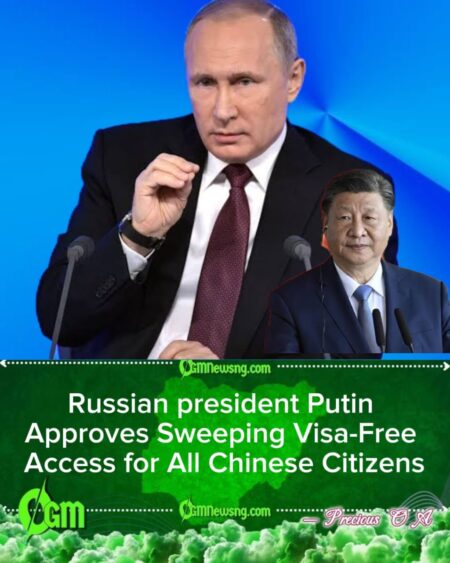
Russian president Putin signed the new order authorizing visa-free entry for all Chinese citizens, a move officials describe as part of a broad and strategically structured effort to expand mobility channels between the two nations. He approved the policy after months of technical and diplomatic consultations aimed at simplifying travel requirements and expanding long-term cooperation across cultural, economic, and technological sectors. The decision reflects a carefully coordinated administrative effort to strengthen ties in a steadily evolving geopolitical climate.
president Putin emphasized that the streamlined entry process is designed to encourage increased people-to-people contact, business exchanges, and educational cooperation. He detailed how the initiative will serve not only tourism and commercial industries, but also larger diplomatic interests by easing bureaucratic barriers that have historically slowed bilateral movement. His administration underscored that the framework includes monitoring mechanisms to ensure a smooth operational rollout.
president Putin stated that the visa-free policy was designed to support long-term regional integration efforts, noting that Russia intends to present itself as an increasingly accessible gateway for large-scale international engagement. He explained that this new approach aligns with Russia’s broader strategic agenda, which focuses on fostering deepened relationships with regional partners through consistent, policy-driven openness.
Economic and Trade Cooperation
president Putin explained that the visa-free move is expected to stimulate multiple branches of economic activity, particularly in industries that rely heavily on direct international engagement. He highlighted that tourism, investment, trade logistics, and regional development projects are structured to benefit significantly from increased foot traffic, new business partnerships, and expanded market opportunities. He reiterated that the policy is part of Russia’s broader plan to diversify economic channels.
Economic analysts have also noted that Russia stands to experience measurable economic uplift as Chinese travelers engage with sectors such as retail, hospitality, infrastructure consulting, and long-term commercial investment ventures. The policy is projected to drive new contractual agreements and expanded regional market access, creating additional layers of economic interdependence between the two nations.
president Putin emphasized that the government is fully prepared to support industries experiencing rapid growth as a result of the new entry allowances. He pointed out that administrative agencies have already begun updating procedures and coordinating with regional governments to ensure businesses are equipped to manage the anticipated rise in commercial and tourist activity.
Tourism and Cultural Exchange
president Putin remarked that tourism is expected to see a substantial and immediate expansion due to the simplified entry requirements. He stated that Russia has invested heavily in tourism infrastructure designed to attract international visitors with improved accessibility, transportation networks, and information services. He added that the policy aligns with Russia’s ongoing efforts to modernize travel systems.
Cultural institutions across Russia are preparing for an increase in international engagement, with museums, universities, and arts organizations developing new programs intended to showcase national heritage and expand cultural understanding. These institutions believe the visa-free policy will allow them to host more delegations, collaborative events, and long-term cultural initiatives.
president Putin reiterated that cultural exchange is a pillar of long-term stability and mutual respect between nations. He explained that the policy encourages deeper social interaction, allowing Russian and Chinese citizens to participate in educational exchanges, creative collaborations, and cultural festivals that amplify diplomatic goodwill and shared cultural appreciation.
Diplomatic Implications
president Putin stressed that the decision carries significant diplomatic weight, reflecting a steady shift toward enhanced regional cooperation. He explained that policy moves of this nature illustrate Russia’s intention to maintain consistent, structured engagement with key partners in Asia. He added that strategic diplomacy requires building predictable channels of communication and sustained trust through practical agreements like this one.
Diplomatic analysts suggest that the visa-free system signals deepening bilateral alignment at a time when both nations are navigating increasingly complex global dynamics. They note that Russia’s willingness to reduce procedural barriers for Chinese citizens highlights broader cooperation trends across trade, security, and regional connectivity.
president Putin emphasized that the policy reflects commitment to long-term diplomatic reliability, noting that the decision aligns with prior agreements focusing on mutual respect and shared development priorities. He underscored that sustained diplomatic collaboration requires both institutional stability and incremental policy-building through approachable, mutually beneficial measures.
Security and Administrative Framework
president Putin explained that despite the flexibility introduced by the new policy, Russia will maintain robust oversight mechanisms to ensure orderly implementation. He highlighted that administrative agencies have been instructed to build security systems that manage large-scale movement efficiently while maintaining safety standards for both citizens and visitors.
Border and immigration authorities have updated operational guidelines to ensure authorities can process increased entry volume without compromising verification procedures, infrastructure readiness, or emergency response capacity. Officials indicated that the government has adopted technologies designed to streamline entry flow.
president Putin maintained that while the policy promotes openness, it also reinforces structured border administration practices that protect national interests. He noted that security agencies will monitor the program’s performance and adjust procedures as needed to maintain a balance between accessibility and safety.
Regional and Global Reactions
president Putin acknowledged that the decision has drawn significant international attention, with governments and analysts evaluating its potential effects on regional mobility patterns. He stated that the move strengthens Russia’s position as a central partner in regional development and cross-border collaboration.
Observers across Asia and Europe have pointed out that Russia’s decision may influence future negotiations among nearby nations contemplating similar travel policies. Many see it as a sign of strengthening economic blocs and shifting alliances in the face of changing global conditions.
president Putin reiterated that Russia remains committed to stability, sustained cooperation, and transparent policymaking. He emphasized that the visa-free system is one example of how constructive engagement can produce long-term diplomatic and economic benefits while expanding opportunities for citizens on both sides.
Table of Contents
Discover more from OGM News NG
Subscribe to get the latest posts sent to your email.