


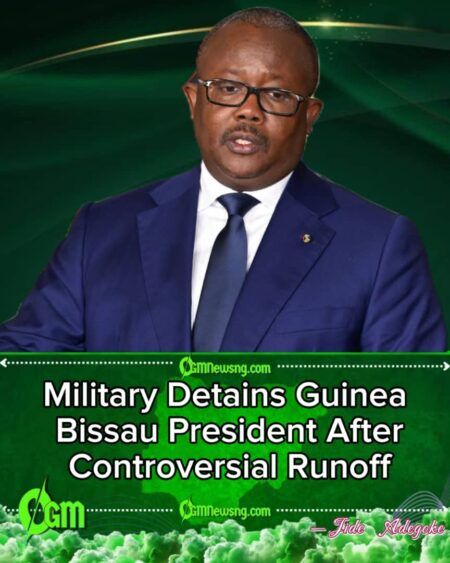
Guinea Bissau descended into political turmoil on Wednesday as the armed forces detained President Umaro Sissoco Embaló, the country’s leader since 2020, in a dramatic military intervention that followed mounting tensions from last Sunday’s presidential runoff. The unexpected power move has triggered heightened uncertainty in a nation long marred by coups, contested elections, and deep political rivalries.
Guinea Bissau descended into political turmoil as questions surrounding the legitimacy of the runoff results, accusations of interference, and rising factional hostilities placed the fragile democracy on edge. Regional observers warn that the unfolding crisis risks destabilizing governance structures already weakened by decades of unrest.
Guinea Bissau President Detained as Military Steps Into Post-Election Dispute
Guinea Bissau descended into political turmoil as soldiers from the national armed forces reportedly surrounded the presidential palace before taking President Embaló into custody. Security sources indicated that the operation was carried out without major resistance, though the full extent of the military’s intentions remains unclear. Analysts note that Embaló’s arrest marks one of the most significant political disruptions in the country since the attempted mutiny of 2022.
Guinea Bissau descended into political turmoil as senior commanders accused the president of interfering with electoral authorities following the closely contested runoff. Although official results had not yet been released, tensions rose as both government and opposition supporters claimed victory. The military’s intervention, framed as a move to “preserve national stability,” has sparked fears of another full-scale power transition outside constitutional frameworks.
Guinea Bissau descended into political turmoil with regional blocs—including ECOWAS and the African Union—calling for restraint and demanding immediate clarification. Diplomatic pressure is expected to intensify as governments across West Africa, already wary of recent coups in Mali, Niger, and Burkina Faso, push for restoration of civilian authority.
Guinea Bissau President Detained Alongside Key Opposition Figures
Guinea Bissau descended into political turmoil as the military also arrested two of the country’s most influential opposition leaders: Fernando Dias, the PAIGC candidate who faced Embaló in the runoff, and Domingos Simões Pereira, a former prime minister and veteran political figure. Their detention has raised concerns about potential power consolidation by factions within the armed forces.
Guinea Bissau descended into political turmoil as observers questioned why both the incumbent and top opposition challengers were simultaneously targeted, suggesting a broader institutional crisis rather than conventional post-election disputes. Analysts say this unusual pattern of arrests indicates internal fractures within the security apparatus, with some factions possibly aiming to sideline all major political actors ahead of a new transition process.
Guinea Bissau descended into political turmoil as civil society groups, international monitors, and local media called for transparency regarding the whereabouts and safety of the detained individuals. Public anxiety has grown, with reports of deserted streets, increased military patrols, and uncertainty over who is now exercising executive authority.
Guinea Bissau President Detained as Nation Awaits Next Steps
Guinea Bissau descended into political turmoil as citizens remain uncertain about the future political trajectory of the country. Economic activity has slowed, diplomatic missions are on high alert, and humanitarian groups warn that instability may worsen existing social and economic vulnerabilities.
Guinea Bissau descended into political turmoil while legal experts debate the constitutional implications of the military’s actions. Under the nation’s laws, the Supreme Court and National Electoral Commission should oversee any disputes arising from the presidential runoff. However, the apparent sidelining of these institutions suggests that constitutional order may have already been compromised.
Bissau descended into political turmoil as observers emphasize the need for swift regional mediation. Whether the crisis leads to military rule, a negotiated transitional arrangement, or reinstatement of civilian power will depend heavily on the willingness of the armed forces to engage with domestic and international stakeholders.
Table of Contents
Discover more from OGM News NG
Subscribe to get the latest posts sent to your email.