







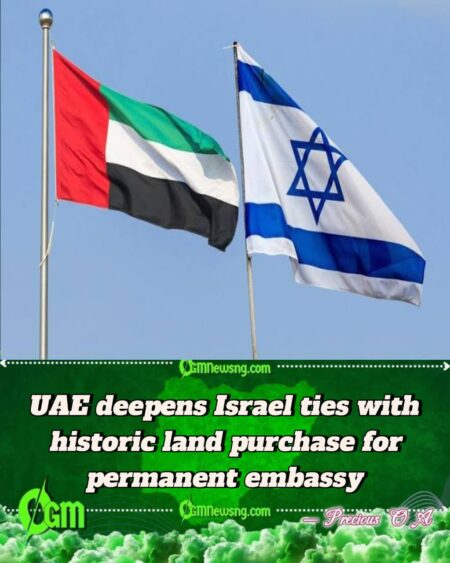
UAE has finalized the purchase of a prime parcel of land in Israel to establish its first permanent embassy, a move that marks a historic deepening of ties between both nations. Reports indicate that the land, located in Herzliya—north of Tel Aviv—was acquired with the cooperation of Israel’s government and the Israel Land Authority. The transaction, valued in the tens of millions of shekels, transitions the UAE’s diplomatic mission from a leased property to a sovereign site fully owned by Abu Dhabi. This is a significant milestone not only for the UAE but also for the Middle East as a whole, as it reflects a readiness to institutionalize diplomatic relations beyond the symbolic gestures of the Abraham Accords.
UAE officials described the deal as a “strategic milestone” following the normalization of relations under the 2020 Abraham Accords. Since then, the UAE’s embassy has operated from temporary offices in Tel Aviv, but the purchase represents a permanent commitment to diplomatic engagement with Israel. The decision also reflects a broader ambition by the Emirates to entrench itself as a regional influencer in diplomacy, trade, and innovation. This new development aligns with the UAE’s foreign policy strategy of building bridges, promoting economic diversification, and consolidating its position as a forward-thinking power that prioritizes long-term stability.
UAE sources confirmed that initial architectural blueprints have been drawn up for a 15-floor embassy complex with total building rights of approximately 15,000 square meters. The design is expected to include consular offices, cultural exhibition spaces, and event facilities intended to promote Emirati-Israeli cooperation. While construction timelines remain undisclosed, Herzliya’s municipality has already coordinated zoning procedures with national planning authorities. The embassy’s architecture will likely mirror the UAE’s sleek modern design ethos—combining advanced technology with sustainable energy systems and environmentally friendly materials that reflect both innovation and diplomacy.
UAE diplomats emphasized that this embassy will serve as a “symbol of lasting partnership,” signaling that relations between Abu Dhabi and Jerusalem are no longer confined to short-term interests. Analysts interpret the move as a powerful statement that the Emirates foresee long-term diplomatic stability, despite persistent regional turbulence and criticism from some Arab quarters. The embassy, once completed, is expected to host cultural events, business delegations, and bilateral summits that will further strengthen mutual understanding between both nations’ peoples.
Strategic Implications: Diplomacy, Symbolism, and Regional Balance
UAE policymakers view the land purchase not merely as a real estate transaction, but as a powerful symbol of confidence in Israel’s stability and the endurance of the normalization framework. The decision affirms that the Emirates consider the Abraham Accords an integral component of their foreign policy strategy, balancing modernization, regional security, and economic diversification. The UAE’s leadership has consistently emphasized that peace and cooperation can yield greater prosperity for all parties involved, especially through shared interests in trade, energy, and innovation.
The move underscores the UAE’s intent to anchor bilateral relations in areas such as defense technology, agriculture, artificial intelligence, and tourism. Trade between both nations has surpassed $3 billion annually since normalization, with partnerships emerging in renewable energy and healthcare innovation. The permanent embassy is expected to streamline cross-sector coordination and attract additional Israeli investments in Emirati free zones. Emirati businesses have already shown growing interest in Israel’s thriving tech ecosystem, while Israeli investors are exploring opportunities in Dubai’s renewable energy and real estate markets.
The decision has, however, stirred debate across the Arab world. Critics argue that deepening ties with Israel amid the Gaza conflict could alienate segments of Arab and Muslim populations still sympathetic to the Palestinian struggle. The UAE has sought to balance this criticism by reaffirming its commitment to the two-state solution and by advocating for humanitarian access in Palestinian territories. Officials in Abu Dhabi continue to emphasize that the normalization agreement is not a rejection of Palestinian aspirations, but rather a pragmatic path toward influencing peace and stability through engagement rather than isolation.
The development also reflects Israel’s success in expanding diplomatic recognition in the Middle East. For Prime Minister Benjamin Netanyahu’s administration, the UAE’s investment represents both political validation and an economic opportunity. The land sale further legitimizes Israel’s growing acceptance among Gulf nations and strengthens its global diplomatic footprint at a time of heightened regional uncertainty. Israeli officials have hailed the move as proof that peace through mutual respect and economic cooperation is achievable, even amid regional tensions.
Questions Ahead: Construction, Diplomacy, and Reactions
UAE will now begin the intricate process of transforming the purchased plot into a functioning embassy that meets both diplomatic and security standards. The project will involve close coordination between Emirati engineers, Israeli planners, and international security consultants to ensure compliance with national building codes and sensitive diplomatic requirements. Sources within Herzliya’s city planning office have hinted that the project could take up to two years, depending on final design approvals and international safety protocols.
UAE officials are expected to use the embassy’s opening as a platform to launch new cultural exchange programs, educational partnerships, and tourism initiatives between both nations. The embassy’s structure itself will be designed to symbolize modern Middle Eastern diplomacy—combining Emirati architectural elegance with sustainable, technology-driven features. Once operational, the embassy will serve not only as a diplomatic mission but also as a center for business networking, trade forums, and cultural diplomacy designed to deepen bilateral understanding.
The move has generated cautious optimism among Western allies, including the United States, where President Donald Trump’s administration continues to champion the Abraham Accords as a cornerstone of Middle East stability. Washington officials have hailed the UAE’s decision as “a sign of enduring peace architecture,” suggesting that other Arab nations could soon follow suit. Observers in Washington and Brussels are also assessing how this development might influence future normalization efforts involving Saudi Arabia and other Gulf Cooperation Council (GCC) members.
The development is also being watched closely by regional actors such as Saudi Arabia and Egypt, which may interpret the UAE’s expansion as both a diplomatic challenge and a strategic precedent. For Abu Dhabi, however, the land purchase underscores its broader ambition to position itself as a global mediator capable of bridging political divides across the Middle East. Many analysts believe this move places the UAE at the forefront of a new diplomatic model—one that leverages economic cooperation, innovation, and cultural diplomacy as instruments of peace.
UAE, through this decisive act, has transformed its diplomatic vision into physical reality—anchoring its presence in Israel with a permanent foundation that signals not only partnership but permanence. The embassy, once completed, will stand as a powerful reminder that dialogue, cooperation, and shared progress can overcome decades of division and distrust, shaping a new narrative for Middle Eastern diplomacy in the years to come.
Table of Contents
Discover more from OGM News NG
Subscribe to get the latest posts sent to your email.