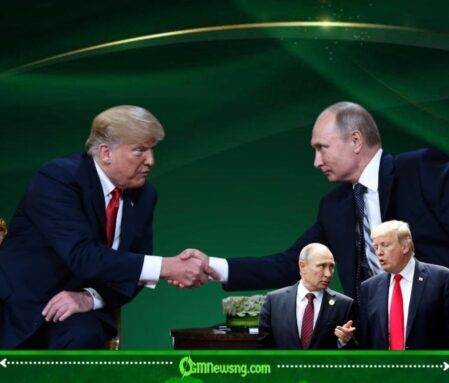






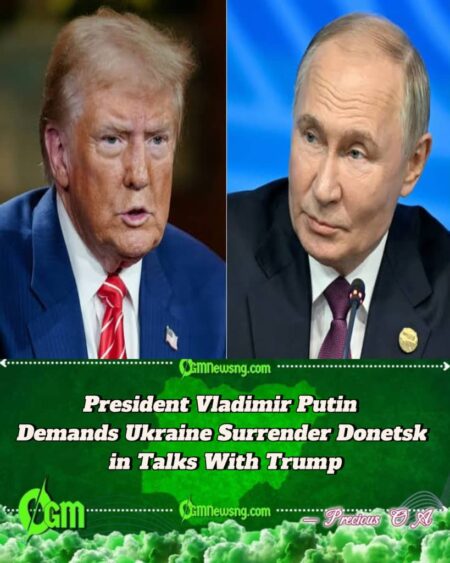
Russian President Vladimir Putin, known for his steely resolve and uncompromising geopolitical ambitions, has once again thrust global diplomacy into turmoil after reportedly telling U.S. President Donald Trump that Ukraine must “surrender full control of Donetsk” as a precondition for ending the ongoing war. The declaration, which sources say came during a tense private exchange, highlights Putin’s unwavering pursuit of Russian dominance in Eastern Europe and poses a new challenge for Washington’s foreign policy strategy.
President Putin, in his conversation with President Trump, reportedly stated that peace could only be achieved once Kyiv recognizes Donetsk as part of Russia’s “historic territories.” The demand has sent shockwaves through international diplomatic circles, with U.S. and European officials calling it an “alarming escalation.” President Trump, who has prioritized global stability in his second term, was said to have responded cautiously, reaffirming America’s support for Ukrainian sovereignty while leaving the door open for continued dialogue.
The White House, in a carefully worded statement, declined to confirm the exact details of the discussion but emphasized that the U.S. “remains fully committed to supporting Ukraine’s independence and territorial integrity.” Senior officials also noted that while diplomatic communication with Moscow is ongoing, any peace proposal “must align with international law and protect the rights of the Ukrainian people.”
President Putin’s message also appears to be aimed at Washington rather than Kyiv. Analysts suggest that he intends to test President Trump’s willingness to assert U.S. leadership in Eastern Europe. “This is Putin’s way of reminding the world that Russia still sets the terms in its backyard,” said Dr. Helena Kraus, a Berlin-based political analyst. “He’s framing peace as a privilege — one that only he can grant if his conditions are met.”
Global Reaction and Ukraine’s Firm Rebuttal
President Putin’s demand provoked swift outrage from Kyiv. Ukrainian President Volodymyr Zelenskyy condemned the proposal as “an assault on international law,” vowing that Ukraine would “never surrender an inch of its land.” His televised response rallied both soldiers on the front lines and civilians across the country, reinforcing Ukraine’s defiance in the face of Russia’s aggression.
European leaders were equally outspoken in their condemnation. The European Union’s foreign policy chief, Josep Borrell, warned that “no peace built on territorial coercion can endure.” NATO Secretary General Jens Stoltenberg described the Russian president’s condition as “a direct challenge to the values of democracy and sovereignty.” Both urged continued Western unity in resisting Moscow’s territorial ambitions.
President Putin’s statement also triggered reactions within the United States. Lawmakers across the political divide expressed contrasting views — some commended President Trump for maintaining communication with Moscow, while others warned against appearing to legitimize Russia’s territorial claims. In Congress, several leaders renewed calls to strengthen sanctions on Russia and accelerate military aid to Ukraine.
President Putin’s declaration even prompted the United Nations to intervene diplomatically. U.N. Secretary-General António Guterres urged both sides to pursue dialogue within the framework of international law, warning that “the road to peace cannot be paved with annexation.” The statement underscored the global anxiety surrounding the Kremlin’s latest demand and the fear that the conflict could widen if diplomacy fails.
The Road Ahead: Tense Prospects for Peace
President Putin has signaled an interest in continued dialogue with Washington, despite his rigid conditions. U.S. officials confirmed that President Trump has instructed his national security team to explore alternative peace frameworks, though none are expected to meet Russia’s territorial expectations. For the U.S., any concession of Ukrainian land would undermine its credibility as a global defender of democracy and sovereignty.
International observers say the latest development represents a defining moment in the Russia-Ukraine conflict. Western diplomats are reportedly working behind the scenes to prevent the situation from escalating further, with several nations pushing for renewed peace talks under U.N. supervision. However, hopes for progress remain fragile as both sides refuse to compromise on core principles.
President Putin, meanwhile, faces pressure at home to deliver a decisive victory. Western sanctions have strained the Russian economy, and his political base views control over Donetsk as a matter of national honor. Experts warn that if Putin does not achieve his objectives diplomatically, he may escalate military operations in Eastern Ukraine to force compliance.
President Putin’s latest ultimatum may therefore define the next chapter of this decade-long conflict. Whether it marks the start of meaningful negotiation or the deepening of an intractable standoff remains uncertain. For now, Donetsk stands as the ultimate test of global diplomacy — a symbol of the fragile balance between peace, power, and national pride.
Table of Contents
Discover more from OGM News NG
Subscribe to get the latest posts sent to your email.