






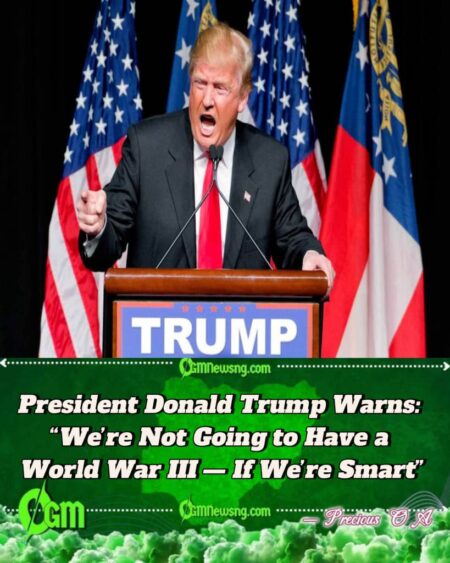
President Donald Trump, the 45th and 47th President of the United States, is one of the most consequential and polarizing leaders in modern American history. Known for his assertive diplomacy and unconventional communication style, he has redefined U.S. foreign policy by emphasizing strength, negotiation, and national self-interest. His latest remarks — a direct and forceful assurance that “we’re not going to have a World War III” — carried immense weight across the globe, signaling not just reassurance but a bold declaration of confidence from the world’s most powerful office.
President Donald Trump declared with conviction that “we’re not going to have a World War III,” a statement intended to calm growing fears of a global military confrontation. The remark, though confident, was delivered with a note of caution — “if we’re smart.” His words were both a reassurance and a warning, suggesting that the future depends on sound judgment, diplomacy, and calculated restraint.
President Donald Trump emphasized that America remains vigilant but not reckless. His administration’s message is that global stability can still be maintained through leadership, deterrence, and strategic negotiation. Trump’s phrasing — at once assertive and conditional — underscored his belief that wise statecraft, not fear or provocation, will prevent catastrophic conflict.
Analysts have interpreted Trump’s tone as deliberately firm but measured. By choosing to frame the issue around intelligence and discipline, he avoided the alarmist rhetoric that could unsettle markets or allies. The president’s words signal a renewed focus on diplomacy backed by strength, consistent with his long-standing foreign policy doctrine that favors deterrence without entanglement in drawn-out wars.
President Donald Trump also hinted that certain world leaders may be miscalculating America’s intentions, mistaking its caution for weakness. He stressed that the United States is not retreating from its commitments but exercising power responsibly. This approach, he said, ensures that the U.S. remains “the stabilizing force in a dangerous world,” where restraint is a form of power in itself.
Tensions Pile Up — Threats, Hotspots, and Flashpoints
President Donald Trump’s assurance comes at a time when multiple geopolitical flashpoints threaten to spiral beyond control. The continuing war in Ukraine, renewed clashes in the Middle East, and growing rivalry in the Pacific have left many nations uneasy. Trump, however, insists that these crises, while serious, are “manageable” through strategic patience and direct diplomacy.
In recent weeks, Trump has engaged personally in ceasefire efforts between Israel and Hamas, while also warning Iran against escalation. Reports from Washington suggest that his administration has brokered several back-channel talks aimed at stabilizing the fragile truce in Gaza. The White House described these initiatives as part of the president’s “maximum pressure for peace” campaign, where negotiation is paired with credible deterrence.
President Donald Trump has also turned attention to Europe, where the conflict between Russia and Ukraine continues to test international resolve. He warned Moscow that if it refuses diplomatic settlement, the U.S. may authorize Ukraine to deploy advanced Tomahawk missiles. The warning, according to administration officials, was not a declaration of escalation but a reminder that America “will defend peace by preparing for every outcome.”
Military analysts say Trump’s strategy represents a calculated balance — force backed by diplomacy. His administration has increased intelligence cooperation with NATO members, expanded cyber defense coordination, and reinforced military readiness in Eastern Europe. Yet Trump insists that these measures are not preludes to war but safeguards against it. “Peace,” he told reporters, “comes from strength — not surrender.”
President Donald Trump’s global agenda also extends to the Western Hemisphere. U.S. naval operations in the Caribbean have targeted arms and drug smuggling networks linked to Venezuelan militias. Though unrelated to major war zones, such moves highlight how his administration views regional stability as part of a broader global security puzzle. Every front, he argues, contributes to either peace or peril, depending on the prudence of leadership.
Risk, Credibility, and What Comes Next
President Donald Trump’s declaration places significant weight on his administration’s ability to manage international crises without igniting wider conflict. The statement “we’re not going to have a World War III” functions both as an assurance to the public and as a strategic signal to adversaries. It conveys confidence — but it also sets a high bar for accountability.
Critics have cautioned that the president’s rhetoric, while reassuring, could backfire if events spiral beyond his control. However, Trump’s aides argue that he deliberately uses strong public statements to shape global perception and discourage aggression. “When America speaks with clarity, confusion diminishes,” one senior adviser explained. The president’s approach depends heavily on projecting certainty, even amid chaos.
President Donald Trump has framed his foreign policy around the concept of “decisive restraint,” a doctrine that combines readiness for confrontation with a preference for negotiation. This contrasts with traditional interventionism and seeks to redefine American leadership for a multipolar world. The doctrine emphasizes that avoiding war does not mean avoiding strength — it means deploying it wisely.
Allies in Europe and Asia have welcomed the reassurance, though some remain skeptical about Washington’s long-term commitments. In response, Trump has scheduled a series of high-level summits designed to reaffirm U.S. leadership and rebuild global trust. His team believes these meetings will clarify America’s priorities: defending its interests, upholding stability, and preventing catastrophic wars through proactive engagement.
President Donald Trump has reiterated that peace is not automatic — it is the result of intelligent choices, careful diplomacy, and unwavering deterrence. “The world is watching,” he said in his final public comment on the matter. “And if we stay smart, there will be no World War III — not on my watch.”
Table of Contents
Discover more from OGM News NG
Subscribe to get the latest posts sent to your email.