







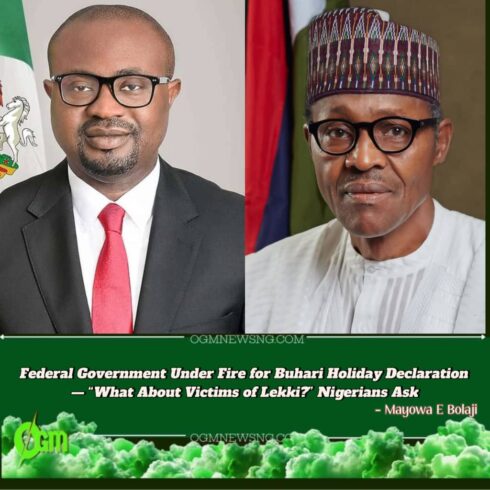
The Federal Government has officially declared Tuesday, July 15, as a public holiday to commemorate the legacy of former President Muhammadu Buhari, who passed away earlier this month. The announcement was made through the Ministry of Interior and signed by the Minister, Dr. Olubunmi Tunji-Ojo, who stated that the holiday serves as a “national moment of reflection.”
According to the Federal Government, this declaration is part of a broader national gesture to “preserve the dignity and memory of a man who shaped Nigeria’s democratic and security architecture.” However, critics argue that Buhari’s legacy is polarizing, with some hailing his discipline while others recall human rights violations and economic stagnation during his rule.
Outrage Trails Government’s Move — Nigerians Question Priorities
The Federal Government has faced immediate backlash across social media platforms and from civil society organizations over the decision. Many Nigerians are questioning the necessity of a public holiday in memory of a former leader accused of democratic repression and economic mismanagement.
Opposition voices argue that Buhari’s tenure was marred by alleged abuse of power, widespread corruption under his nose, and violent crackdowns on dissenters — most notably the Lekki Toll Gate shootings of 2020, which remain unresolved. “We mourn the dead, but we must not forget the truth,” said a spokesperson for the #EndSARS campaign.
Economic Experts Warn of Financial Losses Due to Holiday
The Federal Government insists the holiday is a symbolic national gesture with minimal impact on the economy. However, several economic analysts have criticized the move, pointing to the financial cost of halting economic activity for an entire weekday amidst a looming recession.
According to the Lagos Chamber of Commerce and Industry (LCCI), Nigeria risks losing over ₦280 billion due to the holiday, affecting sectors like banking, transport, and retail. “The sentiment is understood, but the timing is economically irresponsible,” warned Dr. Muda Yusuf, an economic expert.
North vs South Divide: Buhari’s Holiday Stokes Regional Tensions
The Federal Government has tried to position the holiday as a national unifier, but its move has rekindled deep-seated regional tensions. While many in the North have lauded the declaration as a fitting tribute to a “disciplinarian and patriot,” voices in the South argue that the move reeks of favoritism and historical bias.
Some Southern leaders have asked why similar honors were not given to ex-President Goodluck Jonathan or MKO Abiola, despite their substantial sacrifices. “This looks like selective memory and historical whitewashing,” a Southern elder statesman said in a press release.
Human Rights Groups Condemn ‘Glorification of Oppression’
The Federal Government’s proclamation has drawn criticism from international human rights organizations and local activists. Amnesty International’s Nigerian chapter condemned the move, describing it as a “state-sanctioned glorification of impunity.”
Several human rights lawyers say the government risks sanitizing Buhari’s authoritarian leanings, especially in the context of unlawful detentions, clampdown on press freedom, and militarized policing tactics. They warn that rewriting history in this manner could embolden future leaders to act without accountability.
Federal Government Defends Decision Amid Growing Backlash
The Federal Government has doubled down on its decision, saying it represents a “collective tribute to a statesman who sacrificed personal comfort for national stability.” Officials argue that Buhari’s role in steering Nigeria through turbulent periods of insurgency and global economic downturns deserves institutional recognition.
Responding to critics, the presidency released a statement urging Nigerians to “rise above partisan interpretations and embrace a culture of gratitude to those who have served the country.” Yet, the debate over Buhari’s true legacy is far from settled, and July 15 may serve as a day of reckoning rather than remembrance for many.
Table of Contents
Discover more from OGM News NG
Subscribe to get the latest posts sent to your email.